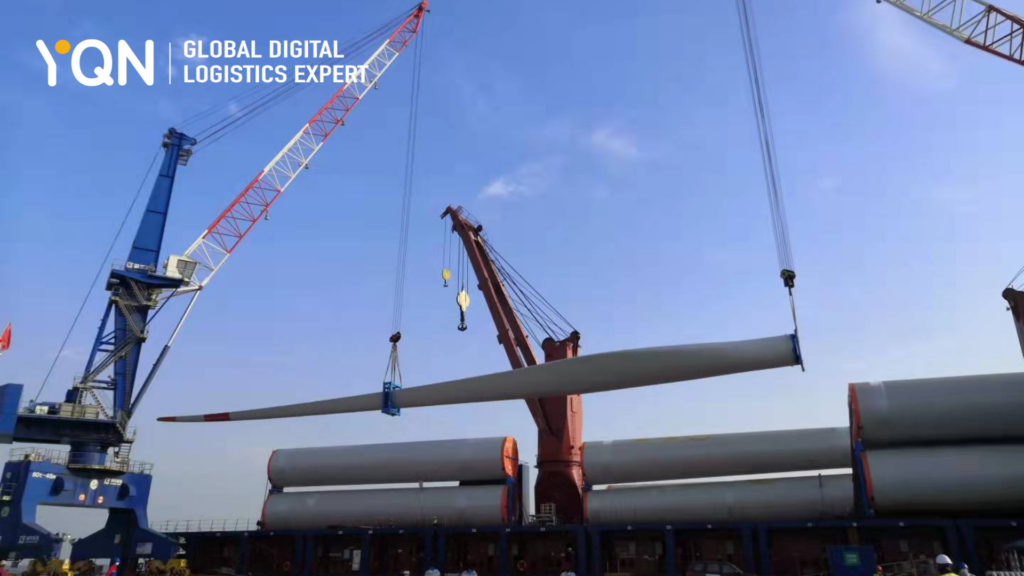
Moving 16 wind turbine sets from China to Southeast Asia was challenging. The cargo included 77-meter blades and tower sections weighing up to 97 tonnes—leaving no room for delays, damage or planning errors.
With construction deadlines already fixed, the developer turned to YQN to coordinate every stage, from factory pickup and heavy-haul transport to terminal operations and ocean delivery.
A Shipment with No Room for Error
Each wind turbine set included three 77-meter blades, five tower sections weighing between 47 and 97 tonnes, a nacelle and a hub. The blades could not be dismantled, while the high-value nacelles and hubs required careful handling and weather protection.
The challenge went far beyond finding a vessel with enough space. Road permits, terminal layouts, truck arrivals and vessel loading all had to follow one coordinated plan. A delay or planning error at any stage could disrupt the entire schedule.
YQN’s logistics team took responsibility for the complete China-origin operation, coordinating every step from the factory to final vessel loading.
Planning the Road Before Moving the Cargo
The first priority was securing a safe route from the factory to the port. For the 77-meter blades, YQN conducted on-site surveys to check road conditions, turning space, overhead cables, traffic signs and other obstacles, while coordinating the required oversized-transport permits.
Hydraulic multi-axle trailers were used for the heaviest tower sections. By distributing the weight evenly, they allowed the team to make precise adjustments along difficult parts of the route.
To improve safety and reduce traffic disruption, the largest components moved between 1:00 a.m. and 5:00 a.m. Each convoy travelled with front and rear escort vehicles and was monitored by local teams throughout the journey.
Dividing the Project into Two Sailings
Moving all 16 sets in one shipment would have created unnecessary pressure at the factory, terminal and destination. YQN therefore divided the project into two carefully planned batches.
Two multipurpose heavy-lift vessels were chartered for the operation. Each vessel was equipped with lifting capacity of up to 700 tonnes, allowing the loading team to handle the tower sections, nacelles and other heavy components without relying entirely on shore-based cranes.
Splitting the project across two sailings also provided greater control over factory release dates and terminal space. It allowed each batch to follow a realistic delivery schedule while reducing congestion during loading.
Preparing the Terminal and Loading Sequence
Before the cargo arrived, YQN worked with the terminal and vessel teams to plan the stacking areas, crane positions, trailer turning space and loading sequence. Truck arrivals were scheduled around the vessel plan to reduce unnecessary handling and keep operations moving efficiently.
Timber dunnage, structural steel supports and custom frames were used to spread the load and protect each component. The high-value nacelles and hubs were placed in adjustable tween-deck spaces, followed by the heavy but regularly shaped tower sections. The 77-meter blades were loaded last so they could be discharged first at the destination.
Securing the Cargo for the Ocean Voyage
Once loading was complete, a professional lashing team secured the deck cargo to prevent lateral movement in heavy seas. Custom flange supports and steel frames kept the blades and tower sections properly positioned while helping maintain the vessel’s stability.
After the securing arrangements were inspected, the vessel departed for Southeast Asia. At the destination port, the operation would be carefully reversed, beginning with the blades before the remaining components continued to the project site.
Keeping Every Team on the Same Plan
The project involved manufacturers, trucking operators, permit authorities, terminal teams, surveyors, vessel operators and destination partners. YQN kept every party aligned through one operating schedule covering both sailings and adjusted the road and terminal plans whenever factory release times changed.
The client received clear updates on cargo collection, port arrival, loading and vessel departure. This reduced manual follow-up and allowed the project team to focus on construction planning at the destination.
Delivered on Schedule and Without Damage
Both shipments departed as planned, and all 16 wind turbine sets reached Southeast Asia on time with no reported cargo damage. Careful route planning, sequenced terminal delivery, customized stowage and secure lashing protected the equipment throughout the journey.
The client also benefited from having one team coordinate the entire China-origin operation, removing the need to manage multiple disconnected service providers.
What This Project Demonstrated
Complex renewable-energy projects require more than heavy equipment and vessel capacity. Success depends on detailed planning, local execution and coordination across every stage.
By connecting the factory, road, terminal and vessel operations through one plan, YQN delivered all 16 sets safely and on schedule—demonstrating its approach of understanding the cargo, identifying risks early and building practical solutions.
Planning a Complex Shipment from China?
If you need to move oversized, heavy-lift or project cargo from China, send your cargo dimensions, weights, origin, destination and required schedule to inquiry@yqn.com.